
Startups attract ambitious people, builders with the dream to change the world and I love that! At the same time typically nobody has a clue of what they’re actually doing. To a certain degree this is a necessity when walking through uncharted territory.
So what do you do, if you’re smart and have no clue what you’re doing? Follow battle-proven best practices! Of course. And where do you get them from? Easy, the industry leaders.
There’s a famous Google “50 shades of blue” experiment. They tested multiple shades of blue for their links in the search results and tested conversation rates. This can be referred to as an A/B Test or more broadly a data-driven decision.
Do you think a startup should do this? Be more “data-driven”?
In 99% cases the answer is no. Let’s assume this is a 0.0001% optimization, while most startups need 10-100x jumps, by finding better product-market fit. Think about it, it’s pure math: Google has ~4.3 billion users. So this change affects roughly half a million people. If you have 1,10,100 or even 1000 customers the effect is zero, nada, zilch.
Best practices are always context-dependent
Best practices do have a purpose and are valuable, if applied in the right context. And that’s the critical evaluation you have to make. Are you in the right stage / context to adopt it?
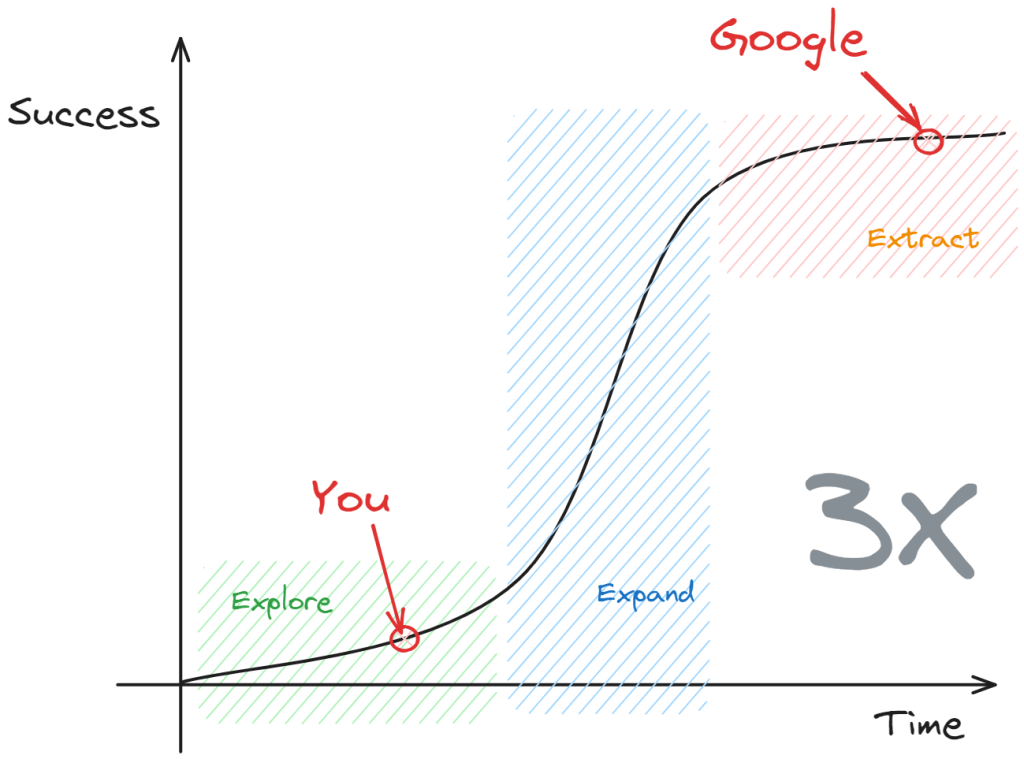
What worsens this common misunderstanding is that most strive to be the next Google, Netflix, Airbnb … you name it. They forget however that these companies have been grinding for decades at this point. They’re in a different stage.
Google, Netflix, Airbnb et al. are in a different stage than you!
Kent Beck’s 3x model describes the different stages companies go through. And depending on the stage many things change. Goals change: scale or finding product market fit? And so do best practices!
Social-Media makes context hard
Social-Media, specifically twitter-like, is amazing to discuss and connect over ideas, rather than people you know. (Just avoid any type of politics…)
Like my content? Follow me on Twitter, by the way. Or Bluesky, by the way . By the way.😉
The short and fluid nature of those posts do not leave enough space for context. It gets problematic if people take every statement literally without trying to understand the context first.
It’s very important WHO and WHY someone is saying something!
Is the recommendation coming from a Netflix Engineer looking to scale or from a startup dev in pursuit of product market fit? Is it a consultant who wants to sell your their products and services?
Theo made a video about this topic targeted at software engineers. And Lane discusses “You’re not qualified for tech opinions”.
FOMO
And that brings us to the last point: FOMO – fear of missing out. When everyone is shouting their ideas and opinions from the rooftops, where does that leave you?! What the others seem to do is so much better and cooler and you have the feeling of being stuck at your “boring job”.
The truth is, though, everyone is stuck in their context. And everyone cooks with water. A Googler may test 50 shades of blue (not even sure if that’s cool?!) but has a gazillion of managers above him who have to sign this off and it takes months to do anything.
Remember: It’s all about context, baby!
Twitter, by the way. Or Bluesky, by the way . By the way. Header image created by DALL-E 3
 An Owl's Perspective
Leave a comment